Thursday, December 23, 2010

Reminiscences

 Chant Ramanama, The Most Comprehensive Panacea


Many persons had gathered and just when ShriMaharaj stopped after having spoken with them, a gentleman reached there, and advancing quickly, he rested his head at ShriMaharaj's feet. Without giving him any opportu­nity to speak, ShriMaharaj began speaking himself. He said, "There was a doctor. Many patients used to visit him. There were in his cupboard bottles full of potions from which he used to dispense appropriate medicines. One day his own son fell ill; thereupon the doctor called him and placed on his palm a pinch of dried ginger powder, and said, "Swallow this." Likewise, I have so far told many things to many, but let me tell you in brief, 'Chant Ramanama. That contains, comprehends, everything to be done in human life, everything." 

Wednesday, December 22, 2010

Reminiscences

A sadhaka should observe the following ten maxims. He should bring his mind to bear upon the subtle differ­ence between the two things mentioned in each.
(1) One should be humble, but not servile.
(2) One should have self- regard, but not conceit.
(3) One be humorous but not sarcastic.
(4) One should be deferential but not acquiescent.
(5) One may love but not be attached and involved.
(6) One may be competitive but not rancorous.
(7) One should be frugal, but not miserly.
(8) One should be generous without being prodigal.
(9) One should be meticulous in one's actions but not rigid.
(10) One should have loyalty for one's religion but not be a fanatic.
There is an assurance from the sadguru that if one practises namasmarana uninterruptedly these virtues will automatically become a part of one's nature.

Tuesday, December 21, 2010

Reminiscences

Nama JapaSaptaha can be observed by an individual, a family, or a group, and may extend over a day, or three days, or seven days. The following is an outline of the routine recommended by ShriMaharaj.
Get up at four in the morning. Pray briefly -------- say for five minutes, bow at the feet of god, and proceed with toilet, bath, etc. From half past five to six chant the matins Bhupalis ,), but don't make these too long ----- that in praise of Rama, Shree Samartha Ramadas, and the Sadguru, will suffice. These should befollowed by the pooja (Worship) and the singing of five psalms. There can be a brief religious discourse if a person who loves God, and is devoted to nama, is available. On the first day of the Japa, a whole coconut should be placed in front of a picture of Sadguru as is common when commencing any religious undertaking. And with that and a prayer, the Japa should commence. The lunch should be finished by about noon. If much delayed, lethargy overtakes everybody. The foods should be simple and the quantity a little short of stomach-full. Boiled rice, wheat or bajra or jowar pancake (bhakari), one simple vegetable (simple to dress and simple to cook), and some dry chutney, should suffice. Jaggery should be served as a delicacy, for it is naturally sweet.
All persons, including the women who cook and serve, should finish their work, and sit down for Japa till about five o'clock, ending with reading from some religious book. This should be followed by a discourse on love for God and nama, if a suitable lecturer is available. He should speak agreeably, excluding slander and criticism of anyone, nor should he attack any one's faith or belief.
When the evening pooja is finished, a light evening meal should be served. It should be light to digest, and very limited in quantity, so that there is no possibility of indo­lence creeping in to obstruct japa. This will also enable the kitchen chores to be minimised, so that even the women can easily participate in the night session of japa. Then the evening aarati and again a brief, half-hour of japa, so that everyone can retire to bed around ten, and there is no difficulty in getting up at four the next morning.
During the Saptaha talking should be avoided, mouna (Silence) observed as far as possible. Just as change of climate invigorates and there is a gain in weight, a japa-saptaha should result in nama pervading the life and thought and awareness to an increasing extent.
ShriMaharaj added, "The main object is to provide a chance for the indulgence of those who have an enthusiasm for nama. The host should have so much faith in nama that those who happen to take food or drink at his place should feel a desire or stimulation for nama. Imagine a number of men and women who are peacefully engrossed in namasmarana, and all with their attention focussed on God: need I describe how much I should like to hang around the place, to linger around with pleasure ?"
There are some persons who are so well-placed that they can, without obstruction, follow some of the hints even as every-day routine and live in namasmarana.


... 179 ...

...178...


Monday, December 20, 2010

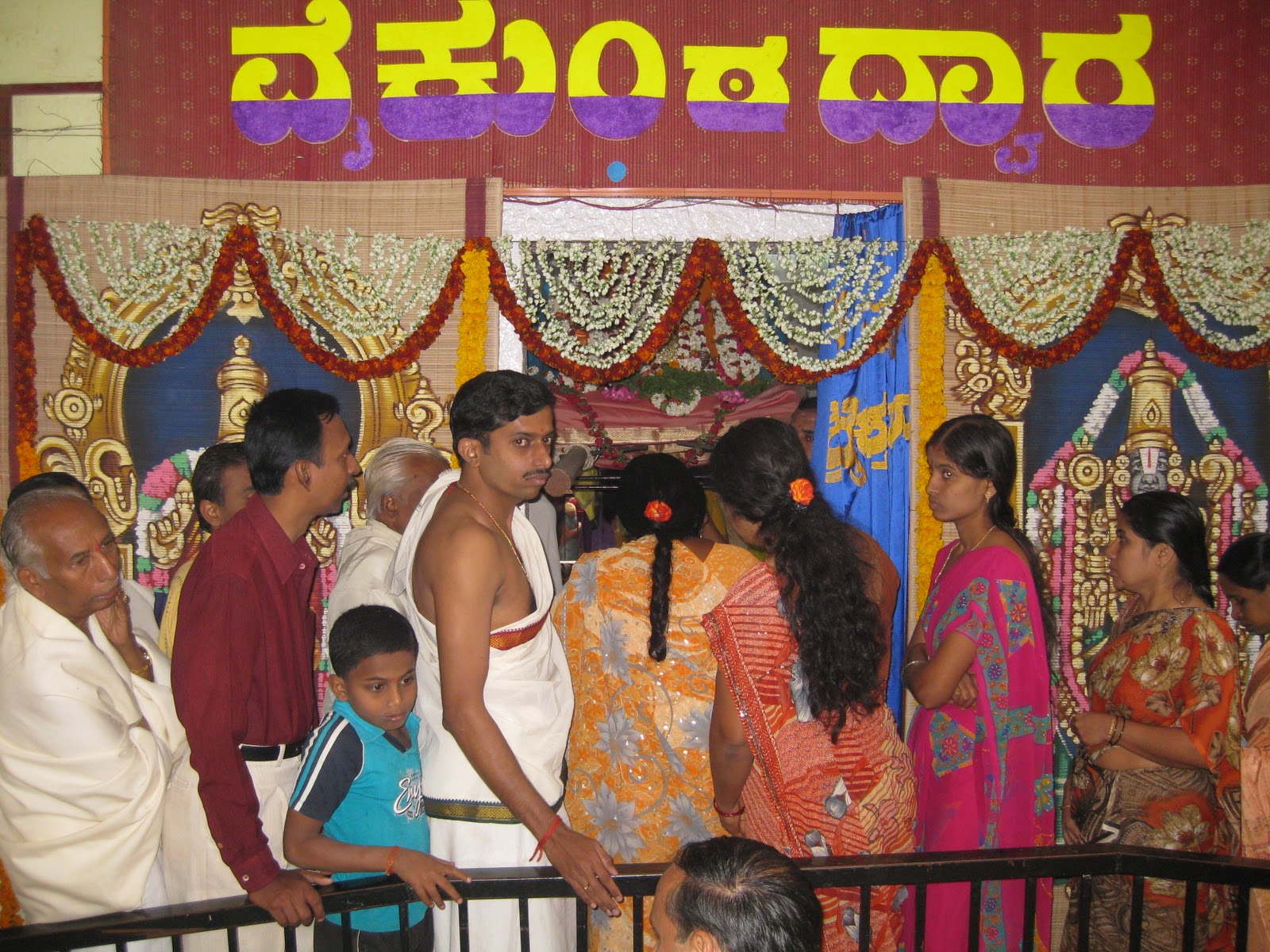
Vaikuntha Yekadashi -17-12-2010 (Friday)


Reminiscences

A couple fell into the habit of frequent bickering with each other. Finally the quarrels came to such a pass that they decided to divorce each other and marry some other person that they would get on better with. Some well-wisher suggested that they had better see ShriMaharaj before taking the extreme step. ShriMaharaj asked, 'What will you do after the divorce ?' 'We shall re-marry a fresh person'. "Is there a guarantee that you will never disagree with that person? 'Both kept mum in answer. ShriMaharaj queried, "If disagreement develops, will the same situation not repeat itself ? Will you then have any recourse but to adapt yourselves to each other ? Then why not do the same today ? Accept each other and learn to adjust to each other's way of life and thought. Place your trust in Rama, think more about Him, pay more and more attention to chanting His nama; by and by you will come to attach less and less value to differences. Rama will be kind; lead happy lives in
thought of Him.
In course of time, the couple adjusted themselves to each other, and came to be known as a happily- married couple.

Sunday, December 19, 2010

reminiscences

Some persons bound for Pandharpur halted at Gondavale en route, to see ShriMaharaj, who, in the course of conver­sation, asked them to partake of prasad before proceeding. The party was basically keen about the business deal they had in mind at Pandharpur, and decided to proceed imme­diately, rather than wait for prasad.  On reaching there they found that they had forgotten at Gondavale the wallet containing the requisite documents. So they had to return to Gondavale. This time they did not neglect to take prasad before leaving for Pandharpur

Friday, December 17, 2010

Reminiscences

Two persons were due to superannuate at about the same time. Of them, one was in sound health, had a wife and children, and was in every way fit. His superior offered him extension of service. His reply was that, as heretofore, he would consult his sadguru and follow his advice. So he asked ShriMaharaj, and, as advised, declined to accept the extension.
The advice was surprisingly against dictates of practical 'common sense1 and the employer pitied the man who blindly obeyed such a Sadguru . As it turned out, the man's son got employed, and there was no loss in the total earning of the family.
The other man who was superannuating about the same time was a widower, without children, and a weakling. ShriMaharaj advised him to apply and try for an extension, and after a deal of importunity got it.
There was, in the eyes of a common, worldly man, a clear contradiction in the advice given by ShriMaharaj. A devotee later sought an explanation. ShriMaharaj ex­plained, ' The second party, already a bereaved one with a frail body, would have only brooded over his ' poor' luck, and made himself more miserable, so it was in his interest to have some occupation in old age; whereas it was only proper for the other person, comfortable in all ways, to spend his leisure in contemplation and service of Rama, rather than continue to serve and employ his physical strength in earning more and superfluous money.